Table of Contents
- Why Busy Men Are Rethinking Their Wardrobes
- How to Choose Sustainable Menswear Brands That Actually Deliver
- Best Sustainable Men's Clothing Brands: A Practical Comparison
- Sustainable Men's Work Clothes That Move From Boardroom to Dinner
- Men's Capsule Wardrobe Essentials: Fewer Pieces, More Outfits
- Durable Men's Clothing Brands: What Longevity Actually Costs
- Care, Fit, and Returns: The Details That Decide Longevity
- Conclusion
- Frequently Asked Questions
Last Updated: October 17, 2026
Why Busy Men Are Rethinking Their Wardrobes
Sustainable menswear brands for busy men solve a specific problem: too many clothes, too few that work together, and no time to fix it. At ARTICL3, we built our entire collection around that frustration.
That shift explains why sustainable clothing has moved from niche to mainstream. Men who travel constantly and still want to look sharp at dinner don't need a bigger wardrobe. They need a system.
How to Choose Sustainable Menswear Brands That Actually Deliver
Choosing well comes down to three checks: the fabric, how the garment is made, and whether the brand answers hard questions without flinching. Skip the marketing language and look for specifics.
Materials That Hold Up
Look for Peruvian Pima cotton and other natural fibers for pieces that directly touch your skin. These fabrics breathe, soften with wear, and resist the pilling that makes cheap clothing look old fast.
Questions to Ask Before You Buy
Ask any brand these five questions before you spend:
- Which specific fibers are in this garment, and where were they grown?
- Where was it cut and sewn, and can you name the factory?
- How many units of this piece were produced?
A brand that answers all five with specifics earns trust. A brand that answers with adjectives hasn't answered at all.
Best Sustainable Men's Clothing Brands: A Practical Comparison
The best sustainable men's clothing brands for busy men build coordination into the collection rather than leaving it to you. That's the principle behind our 2-2-4 System: two trousers, two jackets, and four shirts engineered to work in combination.
Here's how our core pieces compare by use case and price:
Piece |
Price |
Best For |
Why It Earns Its Place |
|---|---|---|---|
$198.00 |
Daily office wear |
Slim Easy fit, clean cut, endless styling options |
|
$228.00 |
Boardroom to dinner |
100% Peruvian Pima cotton, works with a tie or open collar |
|
$139.00 |
Weekend and travel |
98% Peruvian cotton with 2% stretch, softens with each wash |
|
$368.00 |
Elevated casual |
Mid-weight cotton-rayon blend, doubles as a sport coat |
|
$25.00 |
Off-duty |
98% Peruvian blended cotton, 2% Lycra |
|
$40.00 |
Every day |
70% Peruvian Pima cotton, 25% nylon, 5% spandex |
|
$48.00 |
Cold weather |
55% baby alpaca, 45% Drytex, holds shape over time |
Pros of a coordinated system: every piece pairs with every other piece, so mornings require no decisions. Cons: the range is deliberately small, and some men want more seasonal variety than a tight collection allows.


Sustainable Men's Work Clothes That Move From Boardroom to Dinner
Sustainable men's work clothes earn their keep when they survive a full day without a change. A mid-weight jacket over a Pima cotton shirt and clean trousers handles morning meetings and an evening out without looking out of place at either.
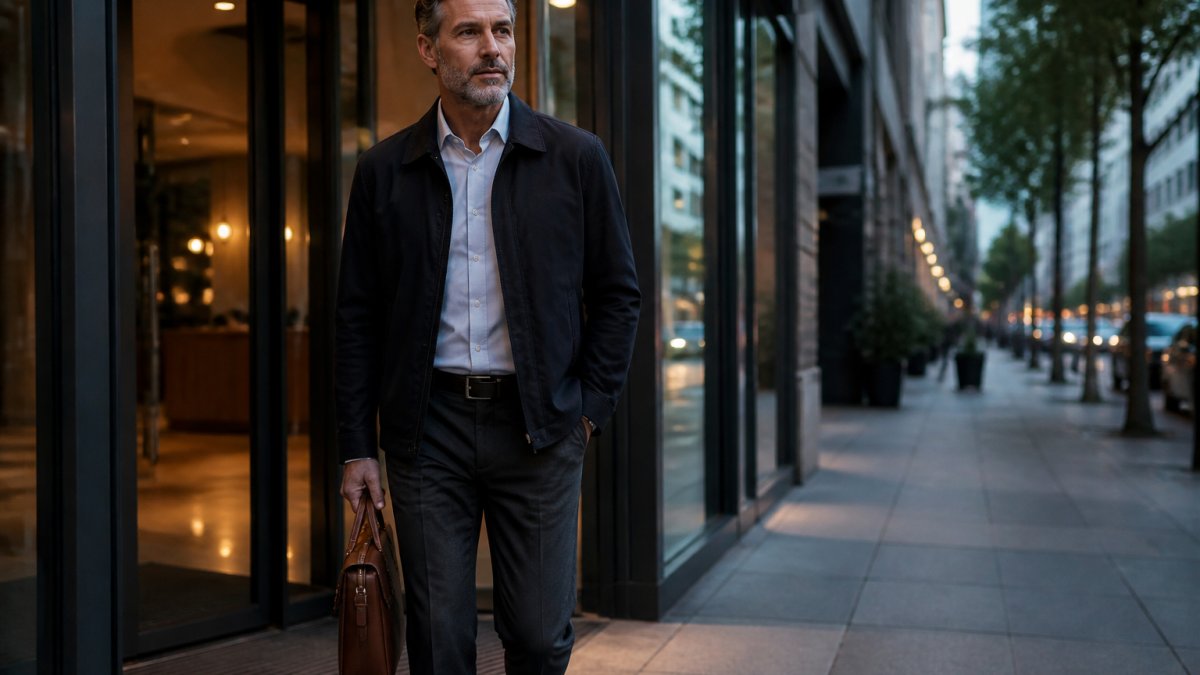
Man in a cotton jacket and trousers leaving a glass office building at dusk holding a leather briefcase
The Captain Shirt does the most work here: designed to be worn with a tie or open collar, it stands its ground under a jacket.
Men's Capsule Wardrobe Essentials: Fewer Pieces, More Outfits
Men's capsule wardrobe essentials follow a simple rule: every piece must combine with every other piece. Eight well-chosen items can produce dozens of outfits, which is why capsule wardrobes appeal to men with no time to plan.
Two trousers and four shirts give you eight combinations before jackets enter the picture. Add two jackets and the count climbs past twenty, a full rotation without a single decision at 6 a.m.
Durable Men's Clothing Brands: What Longevity Actually Costs
Durable men's clothing brands cost more up front and less over time, but that claim only means something if you can see the arithmetic. A $25 tee that survives two years of weekly wear costs about 24 cents per wear; a $10 tee that pills after five washes costs roughly $2 per wear.
Cost-per-wear is the only comparison that matters for a busy man, because it folds price, durability, and versatility into one number: purchase price divided by realistic wears.
Construction Details That Predict Longevity
Marketing copy won't tell you whether a garment will last. Construction will. Look for these signals:
- Fiber content. Long-staple cottons like Peruvian Pima resist pilling because the fibers are longer and fewer ends work loose. Short-staple cotton pills within months.
- Stretch balance. A small amount of stretch, 2% elastane or Lycra, improves movement without turning a garment into performance wear that sags over time.
Our Field Jacket uses 98% Peruvian cotton with 2% stretch and softens with each wash rather than breaking down. That is the behavior to look for: a fabric that improves with age instead of degrading.
The Hidden Costs of Cheap Clothing
The costs of cheap clothing hide in three places. First, replacement: a garment that fails in a year has to be bought again. Second, tailoring: inexpensive garments are cut to average shapes, so alterations add $20 to $60 to the real cost.
A $74 trouser and a $228 shirt look expensive next to fast fashion until you divide by the years you'll wear them. Count only the wears you'll actually get, and durable pieces usually win.
How to Verify Durability Claims
Brands that build durable clothing are usually willing to talk about how. Ask three questions: What is the fabric weight and fiber length? Which seams are reinforced, and where?
Durability is also a sustainability claim. A garment worn for a decade displaces several cheaper replacements, and that displacement is where most of the environmental benefit of sustainable menswear comes from.
Care, Fit, and Returns: The Details That Decide Longevity
Care, fit, and returns decide whether a garment lasts two years or ten, and they're the details most buying guides skip. The goal: a care routine simple enough to follow without thinking, a fit that needs minimal tailoring, and a return policy that removes the risk of buying online.
A Low-Effort Care Routine That Protects Natural Fibers
Most clothing fails because of how it's washed, not how it's made. Heat is the enemy: hot water shrinks cotton, breaks down stretch fibers, and fades dye. A routine that takes five minutes to learn will extend the life of natural fibers considerably.
- Wash cold, inside out. Cold water protects color and fiber structure. Turning garments inside out reduces surface abrasion in the drum.
- Use less detergent than the label suggests. Residual detergent stiffens fibers and attracts dirt. Half the recommended amount is usually enough for everyday soil.
- Skip the dryer when the care label allows. Hang drying preserves shape and stretch. A drying rack costs less than replacing a shirt.
Pima cotton and alpaca all respond well to this routine. Alpaca needs washing even less often than cotton; airing and spot cleaning handle most wear.
Fit: What to Check Before You Buy
Fit is the other half of longevity: a garment that fits well gets worn, and one that fits poorly stays in the closet. Off-the-rack rarely fits perfectly, and tailoring adds cost, typically $15 to $40 for hemming and $20 to $60 for taking in a jacket.
Check these fit points before you commit:
- Shoulders. The shoulder seam should sit at the edge of your shoulder. This is the hardest alteration to fix, so it must be right off the rack.
- Chest and waist. Enough room to move without billowing. A tailor can take in, but cannot add fabric.
- Sleeve and inseam length. Easy to shorten, hard to lengthen. Err long.
Our Ameripean fit is cut to reduce the alterations most men need, which keeps the total cost of ownership down. Whatever brand you choose, try the fit against these four points before you decide.
Returns: Read the Policy Before You Buy
Returns deserve a hard look before you buy, because a generous policy is the cheapest insurance against a fit mistake. Check four things:
- The window. Thirty days is common; shorter windows create pressure to decide before you have worn the piece in real conditions.
- Condition requirements. Tags attached and unworn is standard. Some brands allow try-on; confirm before you order.
- Who pays shipping. A restocking fee or return shipping charge can erase the value of a discount.
- Exchange versus refund. Exchanges for a different size are usually easier and faster than refunds, and they keep the purchase moving.
A generous return policy signals a brand confident in its sizing. A restrictive one tells you to size carefully and expect friction if you guess wrong.
The Real Cost of Ownership
Care, fit, and returns are part of the purchase price. A garment that needs dry cleaning every wear costs more to own than one you can wash cold and hang dry; a piece that needs $40 of tailoring costs more than one cut to fit. Add those costs to the sticker price before you compare.
Conclusion
Building a wardrobe that works takes fewer pieces than most men expect, but it takes intention, finding brands that coordinate their collections, disclose their materials, and stand behind the fit. At ARTICL3, we built the 2-2-4 System around exactly that: two trousers, two jackets, and four shirts that work in harmony, backed by small-batch production and a members' showroom by appointment.
Frequently Asked Questions
What should men look for when choosing an ethical clothing brand?
Start with materials and construction, then check the claims. Look for named fibers such as Peruvian Pima cotton or alpaca blends, and see whether the brand states where the garment was made. Durable construction matters as much as fiber choice: hang-dry care instructions, and limited production runs all point to clothing meant to last. Ask whether the brand publishes labor and sourcing details, and whether care instructions are realistic for your routine. If a claim cannot be traced to a specific material or factory, treat it as marketing until proven otherwise.
How can men build a sustainable wardrobe with fewer pieces?
Work from a fixed number of pieces that all coordinate. A practical starting point is two trousers, two jackets, and four shirts, which yields enough combinations for a full workweek plus evenings out. Choose one color family so every top works under every jacket, then fill gaps only when a piece fails. This approach reduces impulse buying, keeps garment quality higher per item, and makes morning decisions faster. Add socks and a beanie as supporting essentials, and replace items one at a time rather than overhauling the closet each season.
Which sustainable menswear brands make versatile work clothes?
Look for brands that design pieces for more than one setting. A mid-weight jacket with a Nehru collar can serve as a sport coat in a professional environment and as a refined layer over chinos on weekends. Clean-cut trousers in a Slim Easy fit handle office days and travel without looking casual. A long-sleeve Pima cotton pique button-down works with a tie or open collar. The test is simple: if a piece cannot be worn to at least two of your regular occasions, it is not versatile enough to earn space in a small wardrobe.
Are durable men's clothing brands worth the higher price?
Compare cost per wear rather than sticker price. A $228 Pima cotton shirt worn twice a week for three years costs less per wear than a $40 shirt replaced every eight months. Durable pieces also hold their shape, which matters more in professional settings than trend appeal. Check care requirements before you buy: wash-regular, hang-dry garments typically outlast pieces that need dry cleaning or pill quickly. Limited production runs also signal a brand is not overproducing inventory it has to discount, which usually correlates with better materials.
How do I know a sustainable piece will fit if I buy online?
Use the brand's stated fit language and compare it to a garment you already own. Terms like Slim Easy fit or Ameripean fit should come with measurements, so request them if they are not listed. Order one piece first to test the fit before committing to a full set. Confirm the return window and whether tailoring is included or an added cost. If you travel often, prioritize pieces with stretch or a forgiving cut, since those tolerate minor fit differences better than rigid fabrics.
Sources and further reading: Federal Trade Commission Green Guides on environmental marketing claims, U.S. Department of Agriculture organic cotton and fiber standards, Environmental Protection Agency textile waste and sustainable materials guidance.